Generative AI chatbots represent a turning point in digital interaction: no longer rigid tools with predefined responses, but advanced systems capable of understanding and generating human language in a natural and personalized way.
Generative AI chatbots aren’t just a technological evolution: they represent a structural shift in the way companies and consumers communicate. From reactive support tools, they are becoming true intelligent conversational hubs, capable of connecting brands and users in a seamless, personalized, and omnichannel way. In this article, we analyze how they are redefining customer service, social media integration, and digital touchpoints, and what evolutionary scenarios they open up for the future of corporate communications.
Estimated reading time: 8 minutes
Table of contents
What are Generative AI Chatbots
Generative AI chatbots are artificial intelligence-based software that use advanced linguistic models (Large Language Models) to understand questions and generate coherent, contextual, and natural responses.
Unlike traditional chatbots, which adopt pre-defined responses, these chatbots “generate” content in real time, adapting to the user’s context.
Growth and Market Trends of Generative AI Chatbots
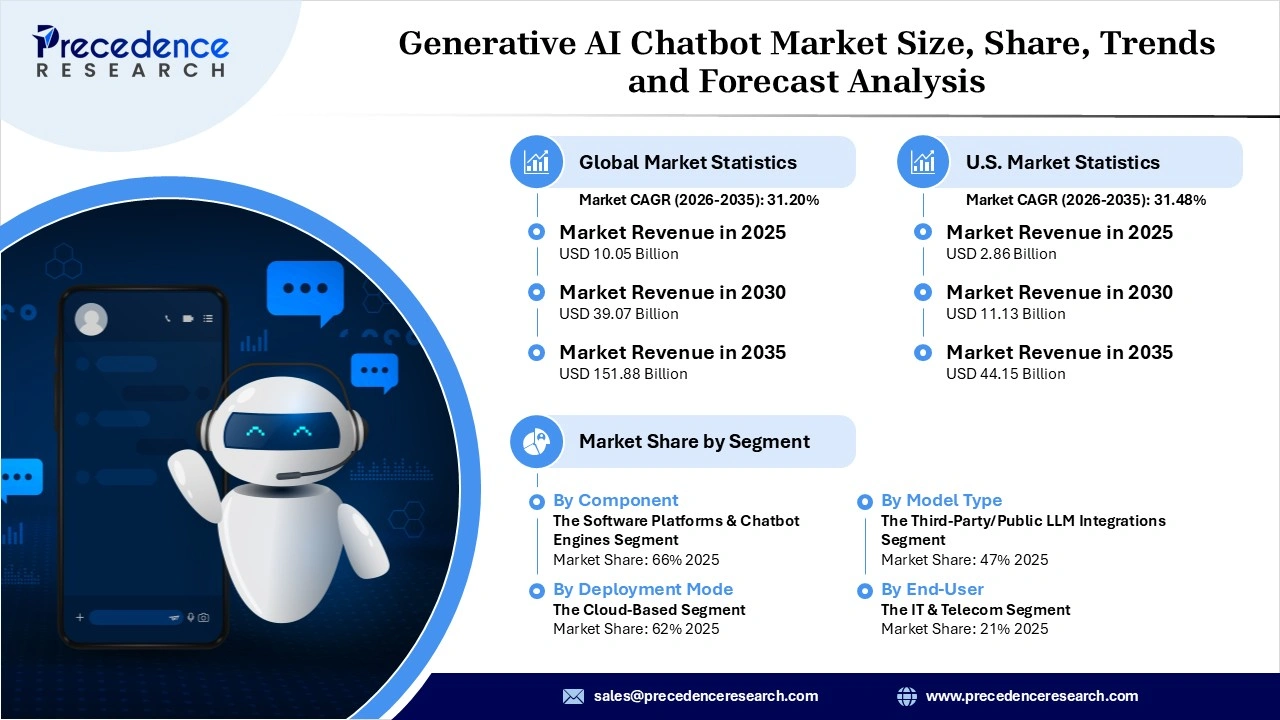
The global market for Generative AI chatbots is booming: its total value is estimated at over $10.05 billion in 2025, with forecasts for it to reach nearly $151.88 billion by 2035 and a compound annual growth rate (CAGR) of over 31% from 2026 to 2035, driven by growing demand for automation, 24/7 customer support, and AI-powered contextual interactions.
At the same time, the Italian artificial intelligence market is also experiencing strong growth: according to the Artificial Intelligence Observatory of the Polytechnic University of Milan, the sector is expected to reach a value of €1.8 billion in 2025, a 50% growth compared to 2024.
A significant share of this national market—approximately 46%—is derived from Generative AI solutions or hybrid projects, a sign that the adoption of conversational and generative technologies in Italy is rapidly gaining ground within the digital ecosystem. Together, these numbers underscore how generative AI chatbots are not just a global trend, but a growing component of AI adoption in Italy as well.
How Generative AI Chatbots Work in New Digital Communication

Generative AI chatbots are based on advanced deep learning models, specifically transformer architectures and large-scale neural networks trained on enormous amounts of text data. At the core of their operation are Large Language Models (LLMs)—such as GPT, Gemini, or Claude—which enable natural language understanding, correctly interpreting user intent, and generating coherent, contextualized, and personalized responses, often in multimodal formats (text, voice, and images). From a technical and operational standpoint, these systems can be easily integrated into websites, mobile applications, customer care platforms, CRMs, and internal business software, primarily deployed in the cloud to ensure scalability, security, and continuous performance updates.
From auto-reply to intelligent conversation
Unlike traditional chatbots, generative AI chatbots don’t just provide canned responses. They interpret context, recognize intent, and adapt their tone to the channel and audience. This transforms every interaction into a dynamic conversation, closer to the human experience.
Digital touchpoints Integration
Today, generative AI chatbots aren’t just on company websites. They’re integrated into:
- Social media (Facebook Messenger, Instagram, LinkedIn)
- Messaging apps (WhatsApp, Telegram)
- E-commerce and mobile platforms
- Help portals and CRM
This widespread presence allows companies to offer a consistent experience across the entire customer journey.ourney.
Omnichannel communication and continuity of experience
Thanks to integration with databases and business systems, the chatbot can retain context and ensure continuity across different channels. A customer can start a conversation on Instagram and continue it via email or website without having to repeat information.
How Generative AI Chatbots Are Changing Customer Service
Generative AI chatbots are revolutionizing the way companies communicate both internally and with customers and partners. Thanks to their ability to understand natural language and generate contextual responses, they enable immediate and personalized assistance, reducing wait times and improving service quality. Within the company, they can support HR, sales, marketing, and IT teams by automating repetitive processes such as ticket management, data collection, or employee onboarding, freeing up valuable time for higher-value activities.
Customer service is one of the areas where this change is most evident.
24/7 support and reduced response times
Generative AI chatbots enable continuous support, eliminating wait times and improving brand perception. Users today expect immediate responses: speed becomes an integral part of the experience.
Large-scale customization
Thanks to data analysis and the ability to interpret requests in real time, the chatbot can suggest products, provide specific information, and tailor responses to the customer’s profile. Communication thus becomes more relevant and targeted.
From reactive support to proactive service
Future evolution will see generative AI chatbots become predictive tools: they will not only respond to requests, but will also anticipate needs, highlight opportunities, and guide users through decision-making.
Why Generative AI Chatbots Make a Difference Today
- More human conversations: They understand natural language and respond with realistic tone and content.
- 24/7 availability: They support customers and users at any time of day, without the need for human operators.
- Reduced operational costs: They automate many customer care, marketing, and support tasks.
Perception of new channels and future prospects
The introduction of generative AI chatbots is also changing the perception of digital channels. Social media, for example, is no longer just a branding or community-building tool, but a true conversational sales and support channel.
Social commerce and conversational marketing
Integrating generative AI chatbots into social media allows you to transform a comment or private message into an instant conversion opportunity. Communication becomes interactive, fluid, and action-oriented.
New standards of experience
With conversational AI, consumers are becoming accustomed to higher standards: immediacy, consistency, personalization. This raises the bar for all companies, even those that haven’t yet adopted AI solutions.
Evolution towards autonomous AI agents
Generative AI chatbots are already evolving into full-fledged AI agents capable of managing complex tasks, coordinating with other enterprise systems, and operating semi-autonomously, always under human supervision.
Benefits for companies and users
Adopting a Generative AI chatbot brings concrete and measurable benefits for both organizations and end users, improving operational efficiency and digital experience.
- Immediate and personalized response for users
Generative AI chatbots provide 24/7 support with instant response times, eliminating waiting and friction in the customer journey. Thanks to Large Language Models, they can understand the context of the request, analyze interaction history, and adapt tone, language, and content to the individual user. This means receiving relevant information, tailored suggestions, and real-time support, both pre-sales and post-sales.
- Automation of repetitive processes for companies
For businesses, generative AI chatbots are a powerful automation tool. They can handle FAQs, support tickets, bookings, data collection, lead qualification, and recurring administrative tasks, freeing up valuable time for human teams. Integration with CRMs, help desks, and business systems also helps reduce manual errors, lower operational costs, and scale the service without proportionally increasing resources.
- Increase customer satisfaction through natural and contextual interactions
AI-generated conversations are fluid, coherent, and human-like. This improves brand perception and strengthens customer relationships. Natural, contextual, and continuous interaction—even across multiple channels (website, app, social media, WhatsApp)—helps increase engagement, retention, and trust. In an increasingly competitive market, offering an advanced conversational experience becomes a true differentiator.
How to Integrate a Generative AI Chatbot into Corporate Communications
How to integrate a Generative AI Chatbot into your company?
- Touchpoint Analysis
Analyze the key touchpoints of your customer journey (website, social, app, e-commerce).
- Goal setting
Define clear objectives: customer service, lead generation, after-sales support, or social commerce.i: assistenza, lead generation, supporto post-vendita o social commerce.
- Integrations
Integrate the chatbot with CRM and business systems to ensure continuity and personalization.
- Monitoring
Constantly monitor and optimize performance, collecting feedback from users.
Conclusions
Generative AI chatbots are redefining communication between companies and consumers, making it faster, more personalized, and omnichannel. However, true innovation lies not only in technology, but in the balance between automation and human interaction.
AI can enhance dialogue, improve efficiency, and create new opportunities for interaction, but trust, empathy, and the ability to understand complex situations remain human prerogatives. The future of corporate communication will not be a replacement of humans with machines, but rather an intelligent collaboration between people and AI systems, in which generative AI chatbots become strategic ally in the service of the customer experience.
FAQ – Generative AI Chatbots
By offering immediate, personalized, and consistent responses across multiple channels, it improves the overall experience and strengthens positive brand perception.
Generative chatbots use advanced AI models to understand natural language and create complex responses, while traditional chatbots follow fixed patterns.
To ensure compliance with a generative AI chatbot, it is essential to combine technical security, data governance, and regulatory compliance. This includes:
Data protection through encryption, anonymization, and controlled access
Transparent information management in accordance with the GDPR and, in the future, the European AI Act
Continuous monitoring of generated responses to prevent errors, bias, or inappropriate content
Human involvement to oversee sensitive or complex interactions
In practice, compliance is achieved by integrating technology, processes, and corporate policies for safe, ethical, and compliant use of the chatbot.