
Understanding how to create a chatbot is a strategic skill for businesses and SMEs that want to stay competitive. It's not just about adopting new technology, but about building an intelligent, always-on communication channel perfectly aligned with the organization's needs.
With the explosion of generative language models and increasingly powerful AI assistants, it might seem that the very concept of a chatbot is obsolete. In reality, the opposite is true.
Chatbots have become true intelligent assistants, capable of understanding natural language, remembering the context of conversations, and acting autonomously within business processes. Unlike generalist tools like ChatGPT, enterprise chatbots are designed to work with specific data, integrate with internal systems, and achieve specific business objectives.
Table of Contents
- How to create a chatbot for business
- With Agentic AI, everything changes
- Before you begin: define goals and strategy
- How to Create a Chatbot: A Practical Guide
- How to Create a Chatbot: The Importance of Integrations
- Measure results and improve over time
- The value for businesses and SMEs
- Conclusions
- FAQ – How to create a chatbot
How to create a chatbot for business {#how-to-create-a-chatbot-for-business}
When discussing how to create a chatbot for businesses, it's important to shift perspective. A business chatbot isn't designed to test a technology, but to solve real problems and support measurable business objectives. For this reason, it must be designed based on processes, not just conversations.
The first key element is alignment with the internal organization. An effective chatbot must reflect the brand's tone, understand products and services, and integrate with existing workflows. Whether it's customer service, sales, marketing, or HR, the chatbot must become a digital extension of the team.
Another key aspect is personalization. In a business context, the value of a chatbot grows when it can recognize the user, retrieve relevant information, and provide contextual responses. This is only possible by connecting the chatbot to company systems and using conversational AI to adapt the dialogue in real time.
Finally, creating a chatbot for businesses means thinking of it as an evolutionary project. It doesn't have to be perfect at launch, but designed to grow over time. Thanks to no-code platforms, companies can quickly update conversations, actions, and integrations, transforming the chatbot into a strategic and increasingly central tool in relationships with customers and collaborators.
With Agentic AI, everything changes {#with-agentic-ai-everything-changes}
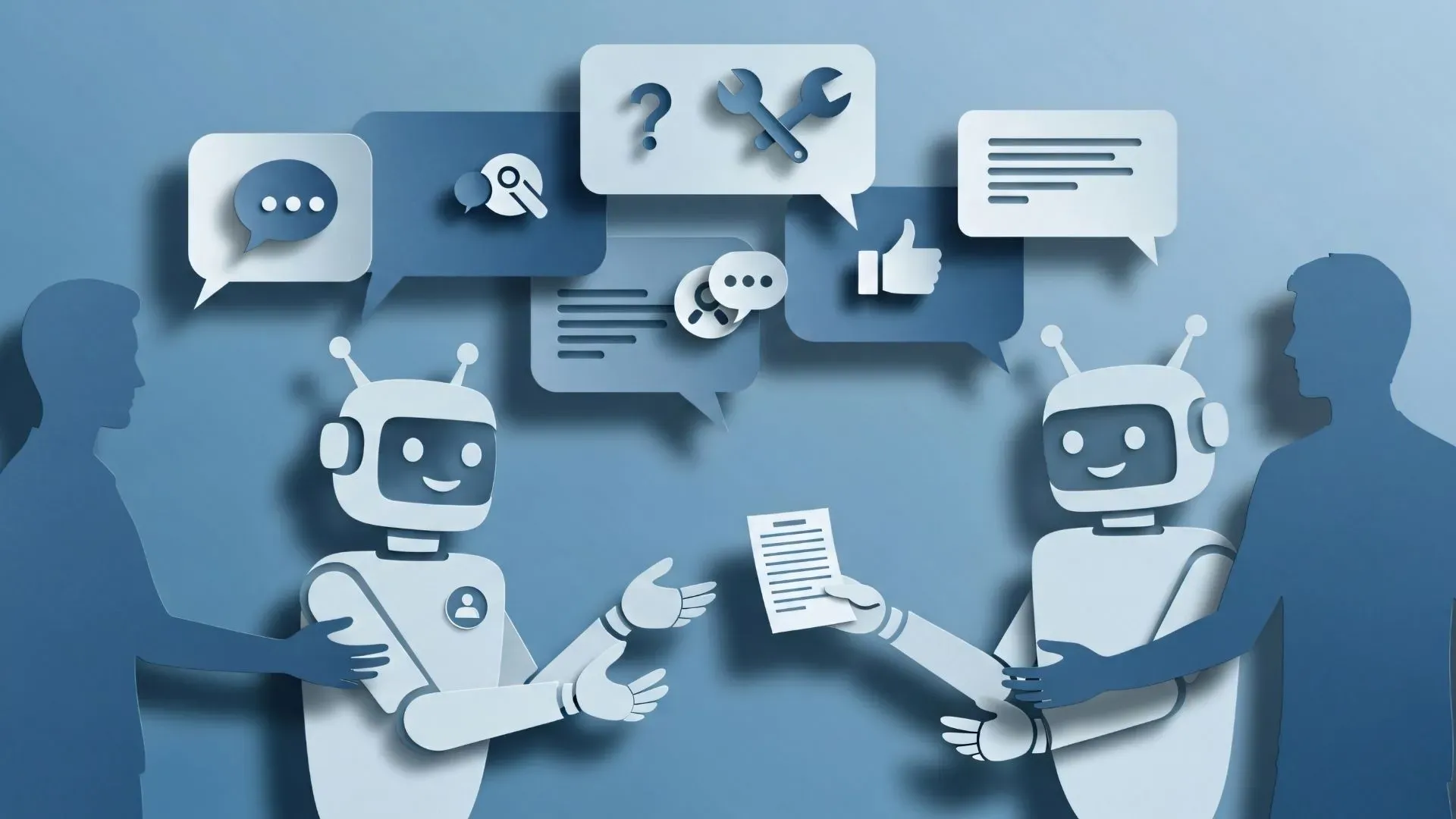
According to a Gartner forecast, by the end of 2026, approximately 40% of enterprise applications will include AI agents specialized for specific tasks, a significant jump from less than 5% currently. This trend indicates that agentic AI is no longer experimental but is becoming a central element of enterprise automation and workflow strategies.
In 2026, we're no longer just talking about conversational chatbots, but about agentic AI. An AI agent doesn't just respond; it can act. This means the chatbot can perform concrete tasks: create a support ticket, update an order, book an appointment, or initiate an internal flow.
Agentic AI represents a paradigm shift. The chatbot becomes a true digital collaborator, capable of interacting with business systems and making decisions guided by rules, data, and objectives. For companies, this translates into intelligent automation and enormous time savings.
Creating a chatbot based on agentic AI means going beyond simple conversation and equipping the bot with real operational capabilities. The first step is to identify which business processes can be automated: bookings, ticket management, orders, or internal requests. Once the objectives are clear, choose a no-code platform that supports AI agents, which allows you to design complex workflows without programming.
Next, define conversational scenarios with integrated actions. For example, if a customer asks about the status of an order, the chatbot doesn't just provide information, but queries the database, updates the status if necessary, and notifies the user. The chatbot must be trained with real business data and tested in realistic scenarios to ensure effectiveness and reliability.
Finally, it's essential to integrate monitoring and analytics tools. Agentic AI is only effective if its actions are constantly measured and optimized. With clear reports on response times, action completion, and user feedback, companies can progressively refine the chatbot's capabilities, making it increasingly intelligent and autonomous.
Before you begin: define goals and strategy {#before-you-begin-define-goals-and-strategy}
Before delving into how to create a chatbot, it's essential to pause and reflect on your objectives. A chatbot isn't a technological project in and of itself, but a business tool. You need to ask yourself what problem it should solve and what value it should generate.
Some companies want to reduce customer service burden, others aim to increase sales or improve the management of internal requests. Each objective requires a different approach. Likewise, it's important to understand your audience: the language to use, the most frequently asked questions, and their level of familiarity with the technology.
Clearly defining the target audience allows you to design relevant and effective conversations. A B2B chatbot will have a different tone and vocabulary compared to one designed for end consumers. Linguistic and cultural contextualization is an often underestimated but fundamental aspect for engagement.
It's also useful to analyze distribution channels: will the chatbot be integrated on the website, mobile app, WhatsApp, or multiple channels simultaneously? Each channel has its own characteristics that influence conversational design. A chatbot on WhatsApp, for example, leverages instant messaging features, while one on a website can use buttons, carousels, and interactive forms.
How to Create a Chatbot: A Practical Guide {#how-to-create-a-chatbot-a-practical-guide}
To quickly clarify how to create a chatbot in 2026, here is a practical guide in five essential steps, designed for businesses and SMEs.
1. Define the goal
Determine what the chatbot needs to do, such as customer support, lead generation, sales, or internal process automation. Without a clear objective, the risk is creating a generic bot that doesn't respond to any specific need. Better to start with a precise use case and scale progressively.
2. Choose your platform
Evaluate different solutions, whether no-code, low-code, or frameworks, based on your company's needs and the complexity of the project. No-code platforms allow you to build advanced chatbots without writing code, reducing implementation time and costs.
3. Design the conversation
Design simple and natural dialogues, starting from the real needs of users. Use conversation maps (conversation flows) to visualize possible paths and ensure the chatbot always knows how to respond, even in the case of unexpected questions or out-of-context requests.
4. Integrate business systems
Connect CRM, e-commerce, and databases to make your chatbot useful and operational. Integrations are the heart of the enterprise chatbot: without access to real data, the bot can only answer generic questions, losing much of its potential.
5. Monitor and optimize
Analyze conversations and improve your chatbot over time based on the data collected. Continuous monitoring allows you to quickly identify gaps and intervene with targeted updates, always ensuring the best possible experience.
How to Create a Chatbot: The Importance of Integrations {#how-to-create-a-chatbot-the-importance-of-integrations}
A truly useful chatbot doesn't exist in isolation. It must be connected to company systems to access the right information and perform concrete actions. Integrations with CRM, e-commerce, management systems, and support tools are essential to offering a complete experience.
No-code platforms make these integrations quick and easy. Even without technical skills, you can connect your chatbot to company data sources and transform it into a true conversational hub.
The main integrations to consider include:
- CRM (e.g., Salesforce, HubSpot): to personalize responses based on customer profile and automatically update contact data.
- E-commerce (e.g., Shopify, Magento): to manage orders, returns, and shipment tracking directly in chat.
- Helpdesk (e.g., Zendesk, Freshdesk): to create and update support tickets automatically.
- Company databases: to access product catalogs, prices, and availability in real time.
- Calendar and booking tools: to book appointments and demos without leaving the conversation.
Each integration adds a level of operational intelligence to the chatbot, making it increasingly capable of solving real problems autonomously.
Measure results and improve over time {#measure-results-and-improve-over-time}
Creating a chatbot isn't a one-time activity. Once launched, it's essential to monitor interactions and analyze data. In 2026, chatbot platforms offer advanced dashboards that allow you to understand what's working and what can be improved.
Observing frequently asked questions, where users get stuck, or where they abandon conversations helps optimize the experience. The chatbot thus becomes a constantly evolving tool, increasingly aligned with business and user needs.
The main KPIs to monitor include:
- Resolution rate: how many conversations are resolved by the chatbot without human intervention?
- Escalation rate: how many requests are transferred to an operator?
- User satisfaction (CSAT): what is the average satisfaction score after conversations?
- Average response time: how long does the chatbot take to respond?
- Conversions: how many leads or sales does the chatbot generate?
This data allows decisions to be made based on concrete evidence, progressively improving chatbot performance.
The value for businesses and SMEs {#the-value-for-businesses-and-smes}
For large enterprises, chatbots are an effective way to scale communications without increasing costs. For SMEs, they are a growth accelerator, capable of improving service quality and competing with more structured organizations.
Thanks to conversational AI and agentic AI, even a small business can offer an advanced digital experience, automate processes, and collect valuable customer data.
Concrete benefits for SMEs include:
- 24/7 availability without additional personnel costs
- Immediate response to the most frequent requests
- Automatic collection of qualified leads
- Reduction of the team's operational burden
- Valuable insights into customer behavior
For large companies, on the other hand, the chatbot becomes a scalability tool: managing thousands of simultaneous conversations without compromising service quality is only possible with artificial intelligence.
Conclusions {#conclusions}
Understanding how to create a chatbot in 2026 means understanding a new way to interact with customers and collaborators. It's not just about technology, but about strategy, experience, and value.
The evolution of conversational AI and agentic AI has made chatbots powerful, flexible, and accessible tools. Thanks to no-code, even businesses and SMEs can design and implement advanced chatbots quickly and sustainably.
The future of digital interactions is already here. Companies that start experimenting and investing in chatbots today will be the ones that offer the best experiences tomorrow, retain customers more effectively, and operate with optimized costs.
FAQ – How to create a chatbot {#faq--how-to-create-a-chatbot}
How long does it take to create a chatbot in 2026?
Thanks to no-code platforms, it's now possible to create a functioning chatbot in just a few days, or even a few hours for simpler use cases. The timeframe depends primarily on the complexity of the conversations and the number of integrations with company systems.
Do you need technical or programming skills?
No. One of the great advantages of modern solutions is the absence of technical barriers. The chatbot can be designed, trained, and improved through visual interfaces, making the process accessible to marketing, customer care, or operations teams.
What are the most common mistakes to avoid when creating a chatbot?
One of the most common mistakes is trying to make the chatbot too complex from the start. It's better to start with a clear objective and simple conversations, then evolve them over time. Another mistake is not connecting the chatbot to company data, thus limiting its actual usefulness. Finally, many companies neglect ongoing monitoring: without constant analysis and optimization, even the best chatbot quickly loses effectiveness.
What is the cost of creating an enterprise chatbot?
The cost varies depending on the complexity of the project, the number of integrations, and the chosen platform. No-code solutions significantly reduce costs compared to custom development. For a personalized estimate based on expected conversation volume, tools like the Crafter.ai traffic calculator are available.
How do you choose the right platform to create a chatbot?
The main criteria to evaluate are: ease of use (no-code vs low-code interface), available integrations with business systems, conversational AI capabilities (NLP, LLM), multilingual and multichannel support, scalability, and pricing model. A platform like Crafter.ai has been specifically designed for the needs of Italian and international companies, with a focus on conversational AI and agentic AI.