
Chatbot statistics are the figures that measure how widely conversational assistants are used in companies and what they produce: how many requests they close without a human agent, how many contacts they turn into customers, how many working hours they take off a department. People who look for them usually have to decide whether to start a project, or have to defend one in front of a finance director.
The trouble is that the numbers in circulation contradict each other. For the same metric you find values from 20% to 90%, almost always without the year, the sample or a definition. On this page we made a different choice: few figures, each with its source or with the project it comes from.
First come the market numbers from Istat, Politecnico di Milano and Gartner. Then the results of the Italian projects built with Crafter.ai, the conversational AI platform by Athics, taken from the use cases published between 2023 and 2026: Sorgenia, Vega Carburanti, Bestway, Humanitas, Nuove Energie, Centrale del Latte di Torino, Emapi and others. For each one we state the measurement period, because a figure without a period cannot be compared with anything. To give a sense of scale: over the last twelve months, as of November 2026, the agents built with Crafter.ai handled more than 5 million messages, counting versions 2 and 3 of the platform together.
Table of contents
- How widespread are chatbots and AI agents in Italian companies?
- Why chatbot statistics do not match each other
- How many requests does a chatbot handle on its own?
- Measured results from Italian projects
- From 2020 to version 3: how the platform has changed
- How long does it take to see the first results?
- How to read a chatbot statistic before trusting it
- What to measure in your own project
- FAQ
How widespread are chatbots and AI agents in Italian companies?
In 2025, 16.4% of Italian companies with at least 10 employees use at least one artificial intelligence technology. A year earlier the share was 8.2%, and in 2023 it was 5.0%. The figure comes from Istat's 2025 survey on ICT in enterprises and says two things at once: adoption doubled in twelve months, and five companies out of six have not started yet.
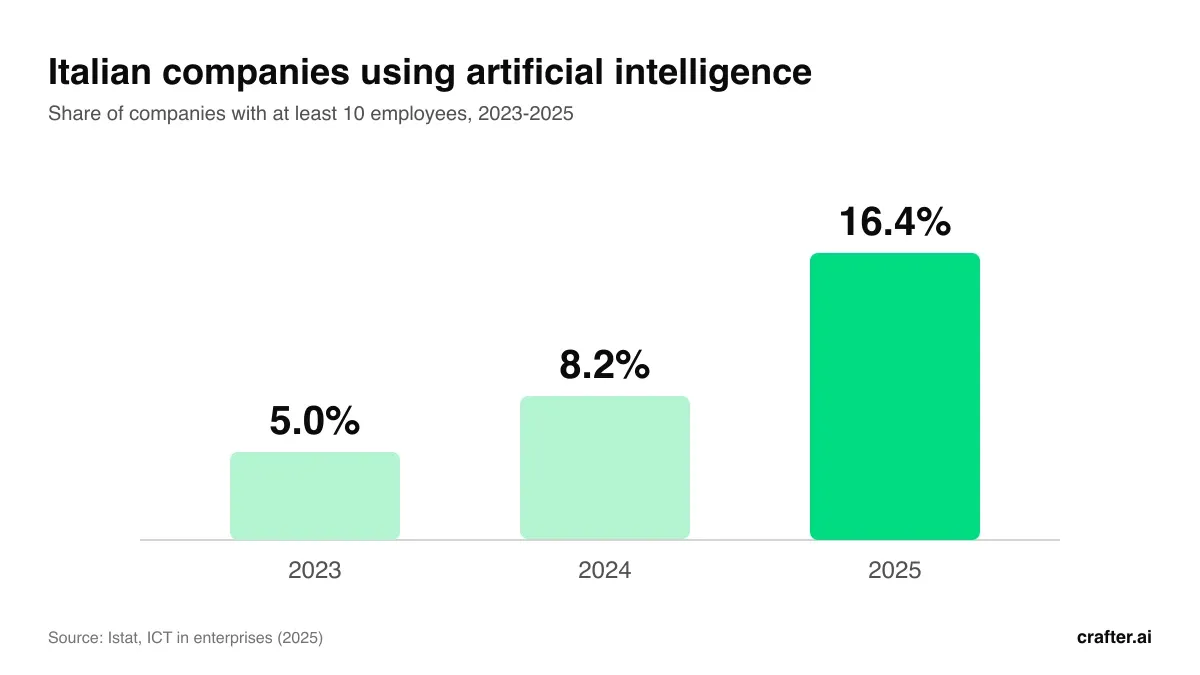
Spending tells a similar story. According to the Artificial Intelligence Observatory of Politecnico di Milano, the Italian AI market was worth 1.8 billion euros in 2025, 50% more than in 2024. 71% of large companies have started at least one project, and 46% of the market value comes from generative AI, alone or inside hybrid projects.
These numbers measure artificial intelligence as a whole, and conversational assistants are only one part of it. Chatbots, AI agents for customer service and voicebots are still among the first projects a company puts into production, because the result shows up within weeks and is easy to count: conversations, handovers to an agent, contracts. For a wider view of adoption, see our guide to AI inside your company.
Why chatbot statistics do not match each other
Chatbot statistics do not match because the people who publish them measure different things and give them the same name. While preparing this article we found, for the share of conversations closed by the bot, declared averages between 20% and 40% in one roundup and between 40% and 55% in another, with peaks of 90% for "top performers". Neither explained how the sample was built. Nearly all of them are vendor pages quoting other vendor pages, which is why we do not report them here.
The confusion comes from three measures that look the same.
- Containment rate: the share of conversations that end without being passed to a person.
- Handover rate: its complement, the conversations transferred to a human agent.
- Resolution rate: the share of conversations in which the customer's problem was actually solved.
The gap between the first and the third matters most. A bot that hides the "talk to an agent" button has a very high containment rate and unhappy customers. A bot that hands over 9% of its conversations and closes the others well is worth far more. When you read "handles 80% of requests", ask which of the three measures you are looking at.
Then there is the denominator. Some count every session that was opened, including those where the user closed the window without typing. Others count only conversations with at least one message. On the same project the two choices can move the result by twenty points.
How many requests does a chatbot handle on its own?
In the Crafter.ai customer service project with the most complete public data, Vega Carburanti, the chatbot handles 97% of requests on its own. The figure was measured over a full year and more than 46,000 interactions.
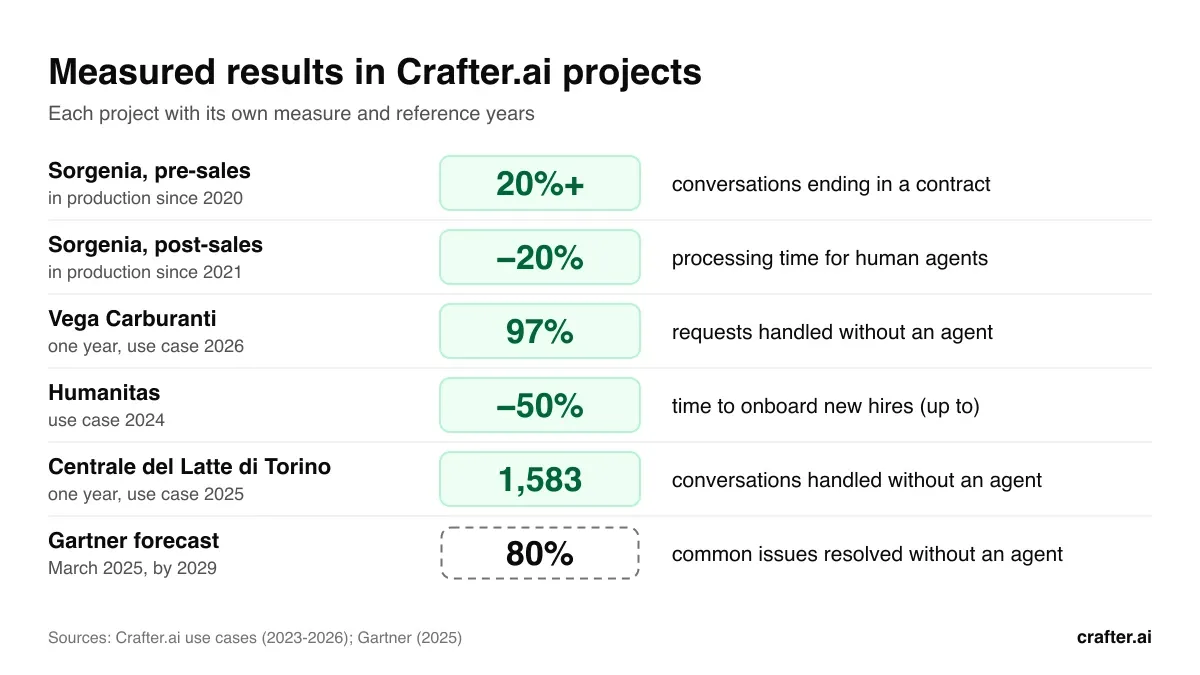
The chart puts Vega Carburanti's 97% next to the results of four other projects, each with its own measure and period. Sorgenia pre-sales, in production since 2020, closes more than 20% of conversations with a contract; in post-sales, since 2021, it took about 20% of processing time off human agents. Humanitas cut the time to onboard new hires by up to 50%, and Centrale del Latte di Torino handled 1,583 conversations in a year. These are different measures and cannot be added up: only the Vega Carburanti figure is a containment rate.
The chatbot of fuel retailer Vega Carburanti took on more than 46,000 interactions in one year and closed 97% of them alone.
As a reference point there is a Gartner forecast from March 2025: by 2029, agentic AI will resolve 80% of common customer service issues without human intervention, with a 30% cut in operational costs. The two numbers are different things. Gartner talks about issues resolved across a whole market. Ours is the containment rate of a single project, where the scope of the questions was defined together with the client. A well-scoped project can sit above 90% today. A general-purpose bot facing any possible request cannot.
Measured results from Italian projects
Over the last twelve months the Crafter.ai platform handled more than 5 million messages (internal figure as of November 2026, versions 2 and 3 together). The table goes into the detail of twelve projects with a public use case. The ones that matter most for size and duration come first. For each we report the figure the document states: where there is a measured percentage you will find it, and where the document describes the result without a number we say so. All projects were measured with platform versions earlier than v3, released in June 2026: further down we explain what changed.
| Project | Industry | Figure or stated result | Period or year |
|---|---|---|---|
| Sorgenia, pre-sales | Energy | More than 20% of conversations become contracts | In production since 2020 |
| Sorgenia, post-sales | Energy | About 20% less processing time for human agents | In production since 2021 |
| Vega Carburanti | Energy, retail | More than 46,000 interactions, 97% handled alone, 70% fewer requests for human intervention | One year, use case 2026 |
| Bestway | Manufacturing, IT help desk | First-level IT support inside Microsoft Teams for a company with more than 10,000 employees; no percentage published | Use case 2025 |
| Humanitas Research Hospital | Healthcare, HR | Onboarding from 3-4 days down to a few hours; time to get new hires started cut by up to 50% | Use case 2024 |
| Nuove Energie | Energy | First-level support and lead capture with callback booking; no percentage published | Use case 2024 |
| Centrale del Latte di Torino | Food | 1,583 conversations handled without an agent | One year, use case 2025 |
| Emapi | Supplementary healthcare | Navigation assistant for an audience of 1,300,000 professionals; no percentage published | Use case 2025 |
| TLC Marketing | Marketing | Campaign redemption 19% higher than email | Use case 2023 |
| AdF, Acquedotto del Fiora | Utilities | More than 2,000 conversations and 11,110 messages | Four months, use case 2023 |
| e-Kanban | Software | 677 cases and more than 10,576 messages | One year, use case 2023 |
| Hello Vacanze | Travel | 45,225 conversations, 9% handover, 65% conversion rate on active interactions | February to September 2023 |
Energy: Sorgenia, Vega Carburanti and Nuove Energie
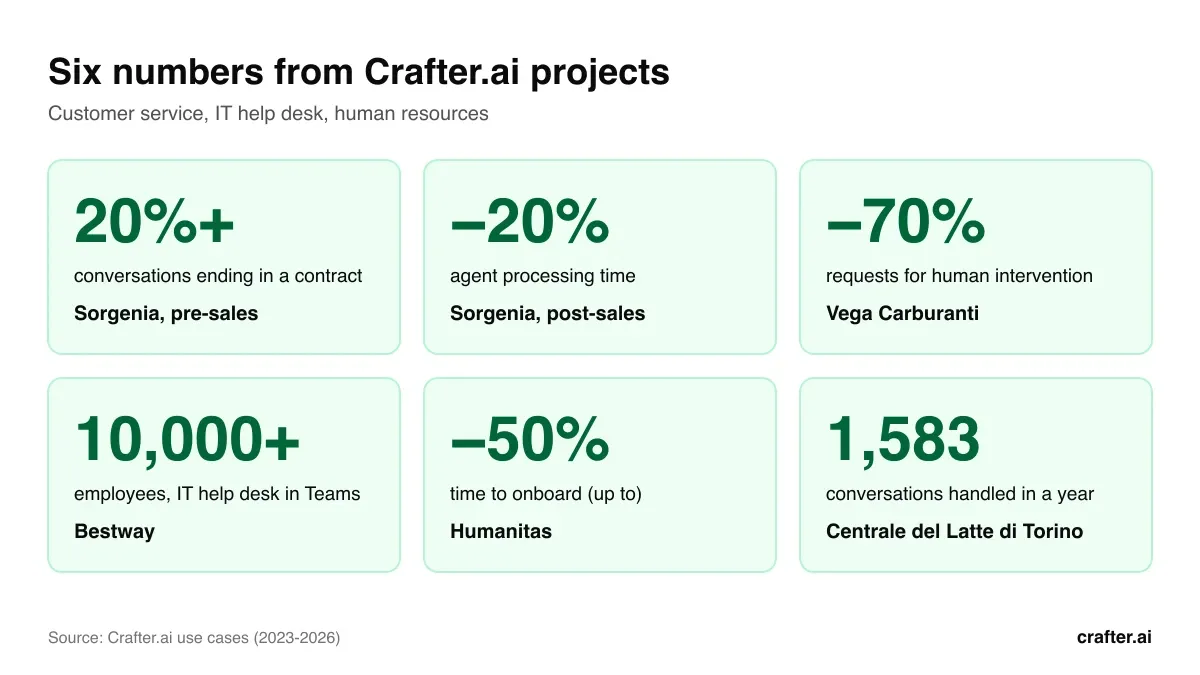
Sorgenia is the longest-running project and the one that lends itself best to being told in full. Gea has been online since early 2020 and works on two fronts. In pre-sales it answers, around the clock, people who are weighing up an electricity and gas offer, and more than 20% of conversations end in a contract. Here the chatbot works as a sales agent and the measure that counts is conversion. In post-sales, live since 2021, the same assistant reduced the processing time carried by human agents by about 20%. At the time, the hours freed were moved to analysing the misses, the messages the bot had not understood. That activity belongs to the technology of those years: with the current version of the platform, based on generative AI, it no longer exists.
Vega Carburanti has a customer care chatbot with generative AI that assists customers and makes it easier to reach the MyVega reserved area. In one year it took on more than 46,000 interactions and handled 97% of them alone. The effect on the department is measured: 70% fewer requests for human intervention, with agents working on the complex cases.
Nuove Energie supplies natural gas and electricity to retail customers and SMEs across Italy. Its assistant, On, handles first-level support on the website, before and after the sale, and when a person is needed it lets the user book a callback from the contact center on the day and at the time they prefer. The use case publishes no percentages. It does report the assessment of general manager Luca Galetti: "The adoption of conversational AI has strengthened our omnichannel strategy and improved the user experience."
IT help desk and human resources: Bestway and Humanitas
Bestway makes above-ground pools and inflatable hot tubs, sells in more than 100 countries and has over 10,000 employees. Its AI agent acts as a first-level IT help desk and lives inside Microsoft Teams: an employee looks it up among their contacts and writes to it as they would to a colleague. The requests are the ones every office knows, such as company Wi-Fi that will not connect, passwords to reset, VPNs to configure, network folders to create. The bot guides the user step by step. If the problem remains, it opens a ticket in Freshdesk by itself and the request moves to the IT team.
Here too the use case states no percentage: it speaks of "a significant percentage of first-level IT requests" resolved automatically. Stefano Garzilli, IT manager at Bestway Europe, says the chatbot is "almost perceived as an always-available virtual colleague". For an internal project, the number to ask for is how many first-level tickets no longer reach the team.
At the Humanitas Research Center the result is measured in time. A virtual assistant guides new hires through their entry paperwork. It used to take three or four days and now takes a few hours, and the time needed to get a person started in the company has dropped by up to 50%. The context explains why the project was born: a center with more than 400 researchers, many recruited from abroad, and growing staff turnover.
Self-service information: Centrale del Latte di Torino and Emapi
Tapporosso is the chatbot of the dairy company Centrale del Latte di Torino. It answers consumer questions about loyalty point collections, prizes and products, which used to land on the switchboard and in the customer service mailbox, and it collects booking requests for events at the company's Latteria. Over the last year it handled 1,583 conversations on its own. The volume is small next to Vega Carburanti, and the project still makes sense: the questions are repetitive, they come back with every new promotion, and the marketing team uses conversation data to understand what consumers ask.
Emapi is the supplementary healthcare fund for Italian self-employed professionals, set up by seventeen private pension bodies. It serves an audience of 1,300,000 professionals and handles about 5,000 requests by phone and email. With its new website it introduced Ema, an assistant that walks the member to the right information and adapts the path to their pension body and coverage. The stated goal is to reduce phone and email requests. The use case does not yet publish by how much.
The other projects
Three smaller projects have a useful number. TLC Marketing uses Frankie, a chatbot on WhatsApp, to contact the partners of promotional campaigns in place of email: the redemption rate went up by 19%. e-Kanbot, the assistant of the e-Kanban software platform, handled 677 cases and more than 10,576 messages in a year. Flùvia, the chatbot of the water utility AdF (Acquedotto del Fiora, Acea group), handled more than 2,000 conversations and 11,110 messages in four months.
Last on the list is Hello Vacanze, an online travel agency: between February and September 2023 the chatbot recorded 45,225 conversations, passed 9% of them to agents and converted 65% of active interactions.
If you want to calculate the ROI of a chatbot starting from these figures, you need three elements: the volumes, the cost of a request handled by a person and the cost of the project. Without one of the three the sum does not close.
From 2020 to version 3: how the platform has changed
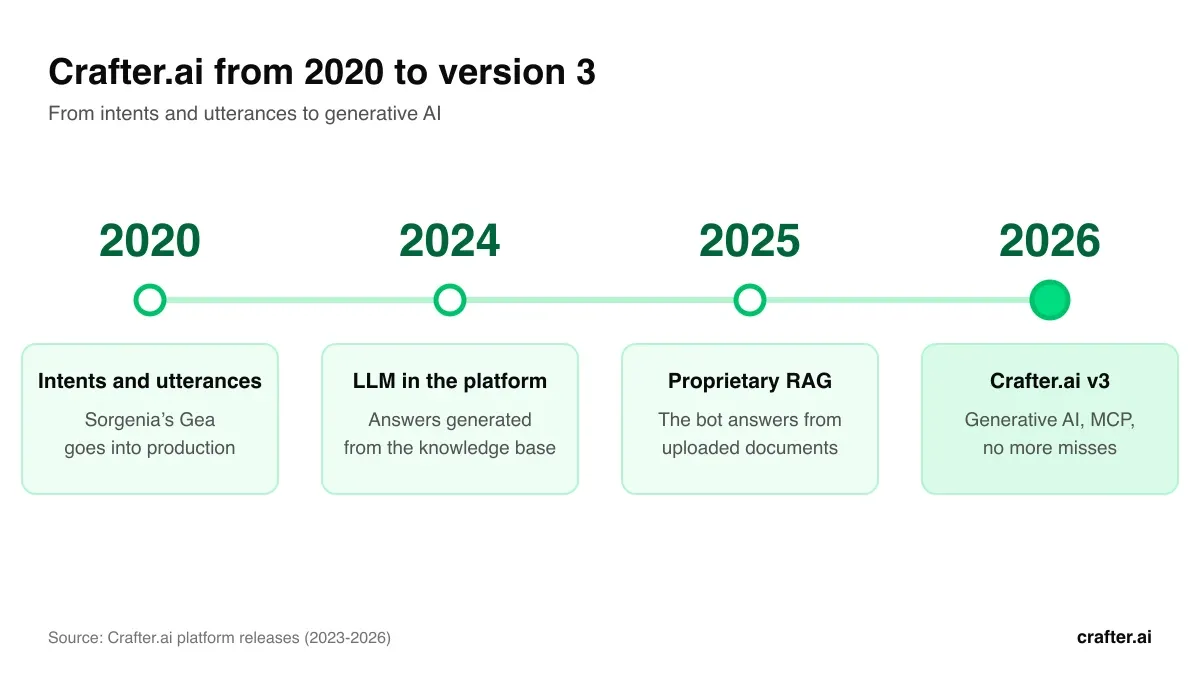
The numbers on this page span six years, and in six years the platform has changed a lot. Sorgenia's Gea went online in early 2020. Crafter.ai reached version 3 in June 2026. All the use cases quoted here were published before that date: the results were obtained with earlier versions.
In the early years a chatbot was built with intents and utterances: for each question you listed by hand the wordings a user might type. When someone wrote a sentence nobody had foreseen, a miss was born, a message the bot did not understand, and a person had to pick it up and assign it to the right intent. The work never stopped, to the point that in December 2023 the platform released a feature made to lighten it, the automatic recalculation of misses.
| When | What changed |
|---|---|
| 2020 | Sorgenia's Gea goes into production: chatbots built with intents and utterances |
| December 2023 | Automatic recalculation of misses, to cut maintenance |
| April 2024 | Large Language Model in the platform: answers generated inside the perimeter of the knowledge base |
| January and May 2025 | Document Manager and proprietary RAG: the bot answers from uploaded documents, guided by a system prompt |
| June 2026 | Crafter.ai v3: platform redesigned around generative AI |
| July 2026 | MCP Tools and bot configuration from an external AI assistant |
| August and October 2026 | Voicebot and GPT-Live Voice: platform users take their own bot to the phone by themselves |
With v3 the bot is no longer trained sentence by sentence. You upload company documents and generative AI answers using RAG. For sensitive content, such as prices and terms, you add Q&As with a fixed answer. A single system prompt sets tone, limits and what to say when the information is missing. Miss management no longer exists: there is no list of misunderstood sentences to clear one by one. What remains is a much lighter check, which is looking at frequent errors in the analytics and adding the missing document or Q&A.
v3 also put voice within reach of people who use the platform on their own. A voicebot used to require a custom project. Now you switch it on from the Connectors section: you choose the synthetic voice, the bot version and what happens at the start of the call, and the phone is answered by the same bot as the website, with the same knowledge base, the same Q&As and the same flows. Since October 2026 there is also GPT-Live Voice, where the call is handled by a live voice model and the bot works behind the scenes.
This changes how historical data should be read. Containment percentages stay comparable, because they measure the outcome of the conversation and not the technology behind it. What changed is the work needed to reach and keep them. The full list of new features is on the latest released features page.
How long does it take to see the first results?
A custom project built by the Crafter.ai team goes into production in 4 to 8 weeks on average. That time covers the analysis of incoming requests, the preparation of the knowledge base, the integrations with company systems and the tests.
If you sign up to the platform and build the agent yourself, timing depends on three things: how many hours you can give it, what kind of project it is (an assistant that answers frequent questions is quicker than one that reads orders from an ERP) and how you work. You can configure everything by hand from the interface. Or, since July 2026, you can connect to the platform through an MCP server and get help from a language model, Claude for example, which creates flows, instructions and content from a description in plain language. The second route shortens the building phase a lot. It does not shorten the part that counts most, which is collecting company content that is correct and up to date.
A reference for small projects is ASD Precision Skating in Milan, a sports association: the agent that answers enrolment requests for the Hot Shivers team was up and running within a few weeks. If you are starting from scratch, the guide on how to create AI agents describes the steps one by one.
How to read a chatbot statistic before trusting it
A chatbot statistic is reliable when it states four things: the period, the total number of conversations, the definition of the metric and the term of comparison. If one is missing, the number can be true and useless at the same time. For figures from a few years ago, it is worth asking which version of the product they were obtained with.
Take "the chatbot handles 97% of requests". Put like that, it cannot be assessed. In the Vega Carburanti use case the same sentence has a period (one year), a total (more than 46,000 interactions) and an effect measured on the department (70% fewer requests for human intervention). With these three elements a customer service manager can run the numbers for their own company.
The same check applies to our data. These are numbers published in use cases written together with clients, so they describe projects that went well: they are no average of all projects. And some have no number at all: for Bestway, Nuove Energie and Emapi the documents describe the result without a percentage, and we did not add one. They help you understand what is reachable inside a well-defined scope, and they are no promise for every case.
There is one practical piece of advice. When a vendor shows you a percentage, ask for the handover rate with the period and the total number of conversations. It is the hardest figure to dress up, because every transfer to an agent leaves a trace in the contact center systems. If the answer is vague, the other numbers will be too.
What to measure in your own project
Before starting a project, pick a few metrics and record the starting value. Without a before there is no after, and six months later nobody remembers how many calls came in during March.
For a customer service project there are three measures: total conversations, the share transferred to agents and the requests that still arrive by phone or email on the same topics. For a sales project you need conversion, defined on a precise event such as a quote, an appointment or a contract. For an internal process you measure time: how many days the task used to take and how many it takes now.
The most common mistake is measuring only the bot. The Sorgenia and Vega Carburanti results carry weight because they were read together with contact center data. If the chatbot reports 95% containment and phone calls do not go down, there is a problem the bot's dashboard does not show.
If you want to understand which of these numbers are realistic for your company, you can start from the Crafter.ai solutions for customer care or read the full use cases on the clients page.
FAQ: chatbot statistics
How many Italian companies use artificial intelligence? According to Istat, in 2025 16.4% of companies with at least 10 employees use at least one AI technology. In 2024 it was 8.2%. Among large companies the share is much higher: the Politecnico di Milano Observatory reports that 71% have already started at least one project.
How many messages does Crafter.ai handle in a year? More than 5 million over the last twelve months, as of November 2026. The figure adds up the messages handled by agents on versions 2 and 3 of the platform.
How many requests can a chatbot handle without a human agent? It depends on how well scoped the project is. In the Vega Carburanti customer service project, built with Crafter.ai, the chatbot closes 97% of requests on its own.
Does a chatbot really reduce contact center workload? Yes, when it answers repetitive questions. Vega Carburanti recorded 70% fewer requests for human intervention after one year. In Sorgenia's post-sales service, agent processing time went down by about 20%.
What conversion rate can a sales chatbot reach? There is no value that fits everyone, because the event being counted changes. In Sorgenia pre-sales more than 20% of conversations end in a signed contract. Other projects count a lighter event, such as a calculated quote or a booked callback, and reach much higher percentages. These are different events and should not be compared with each other.
Do the use case results also apply to Crafter.ai version 3? They were measured with earlier versions, because v3 was released in June 2026 and the use cases were published before that. The metrics stay the same. What changes is how the bot is built and maintained: with generative AI you work on documents and on the system prompt, and manual handling of misunderstood messages is gone.
How long does it take to put an AI agent into production? A custom project takes 4 to 8 weeks on average. If you build the agent yourself on the platform, timing depends on the hours you put in and on the type of project.
Why are the chatbot statistics found online so different? Because different measures end up under the same name: conversations not transferred, problems solved, requests avoided. The way conversations are counted and the type of company change too. A percentage without a period, a total and a definition cannot be compared with another one.