If until recently imagining a supermarket with artificial intelligence could have seemed like a futuristic scenario, today Retail Artificial Intelligence is proving to be an extraordinary lever to increase productivity, improve operational efficiency and offer increasingly personalized shopping experiences.
Large-scale retail trade is increasingly recognizing the importance of adopting new technologies: the growth of Retail Artificial Intelligence in the Italian market is expected to be almost 30% per year until 2028, with the majority of Italian retailers recognizing its strategic importance (Eurostat). This is no longer an emerging trend, but a structural transformation that is redesigning the organized distribution sector.
Table of Contents
- Retail Artificial Intelligence & Generative AI
- How to use Retail Artificial Intelligence
- What do Autonomous Agents do in Retail
- Understanding consumers with Retail AI
- Retail Artificial Intelligence in supermarkets
- Conclusions
- FAQ
Retail Artificial Intelligence & Generative AI {#generative-ai}
The Retail AI revolution is entering its third wave. After predictive and generative AI, autonomous agents that can complete shopping tasks without human intervention are emerging as the next frontier.
The "Consumer Goods Industry Insights Report: AI Edition" by Salesforce reveals that 32% of consumer goods companies have already fully implemented generative AI, with digital commerce being the primary focus area. As the technology evolves — from simply answering questions to taking action — brands and retailers are faced with urgent decisions about how to adapt their digital presence, product content and media strategies.
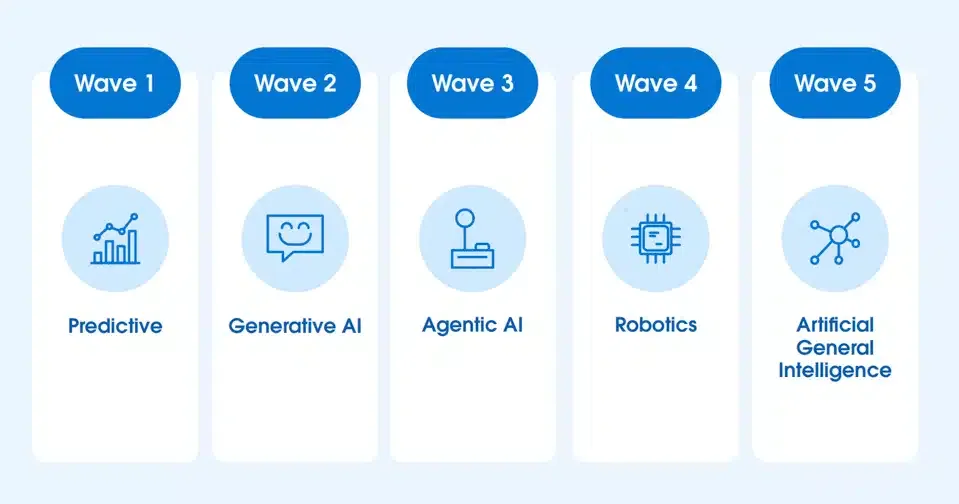
The evolution of AI in 5 waves: from Predictive AI (2014), to Generative AI (2022), to Agentic AI (2024). The fourth wave will be agent-powered robotics. The fifth and final wave will be general artificial intelligence. — Source: Consumer Goods Industry Insights Report: AI Edition
The transition from generative AI to agentic AI represents a fundamental shift in capabilities. While chatbots and assistants like Amazon's Rufus can answer product questions, autonomous agents can complete entire shopping journeys with minimal human intervention. The research also found that 44% of consumer goods executives have already implemented generative AI solutions in customer service, an area perfectly suited to automating repetitive tasks such as handling simple requests, order support, and product recommendations.
How to use Retail Artificial Intelligence {#how-to-use}
Using Retail Artificial Intelligence means transforming every phase of the purchasing experience and operational management into a more intelligent, efficient and personalized process. The main areas of application are:
1. Customer Care Retail ChatbotCustomer care chatbots are available 24/7 to answer questions about orders, returns, products or store hours. They automate request management, sending real-time updates via WhatsApp or proprietary apps, drastically reducing response times and cost per interaction.
2. Marketing Retail ChatbotMarketing AI solutions enable automatic sending of promotions based on the purchasing behavior of individual customers. Chatbots interact on WhatsApp and social media with quizzes, games, surveys or new product launches, generating qualified and measurable engagement.
3. Sales Retail ChatbotSales AI Agents provide automatic product suggestions while browsing or purchasing and guide the user through checkout, reducing cart abandonment rates and increasing average order value.
4. HR ChatbotHR AI solutions guide new hires through company processes, offer on-demand training content and automatically manage questions about vacation, payroll, shifts or internal regulations — freeing the HR team for higher-value activities.
5. Logistics ChatbotLogistics chatbots inform customers and internal operators about delivery status in real time. In case of delays or problems, the chatbot automatically reports the event and proposes alternative solutions, ensuring proactive and transparent communication.
6. Supply Chain Chatbot Connected to management systems, supply chain chatbots signal stock shortages or overloads and, integrated with predictive models, inform employees in advance of potential logistical criticalities or reordering needs.
What do Autonomous Agents do in Retail {#autonomous-agents}
If until yesterday retail chatbots were limited to providing pre-set answers to customer questions — product information, assistance during site navigation, order updates — today autonomous AI Agents act actively based on complex and dynamic objectives. The approach goes from a simple interaction to a real intelligent collaboration between customer and system.
They guide users in finding the best products {#product-search}
AI Agents don't just propose a list of options, they learn in real time from the user's behaviors and preferences. They analyze the context — seasonality, market trends, stock availability — and provide personalized recommendations, anticipated with respect to expressed needs. This level of contextual intelligence transforms the chatbot from a simple assistant into a digital purchasing consultant.
They add items to the cart automatically {#cart}
It's no longer just one-off suggestions: agents build complete proposals. If a customer is shopping for ingredients for a recipe, the agent can autonomously add all related items to the cart, suggest discounted variants and adapt the list based on memorized dietary preferences. This proactive behavior increases the average cart value without being intrusive.
They automate promotion management {#promotions}
Agents can create, test and optimize personalized promotional campaigns without direct human intervention. They adapt offers, discounts and promotions in real time based on purchasing trends, customer feedback and market data. With the ability to analyze huge volumes of structured and unstructured data, chatbots can offer highly personalized product recommendations in real time, increasing conversion rates and customer satisfaction.
As a Retail AI solution, autonomous agents can personalize sales communications, propose tailored offers, automate the creation of promotional content and analyze customer feedback to continuously optimize campaigns. Finally, they don't just interact with customers: they can also support internal employees by suggesting promotions, generating reports on product performance or helping buyers manage orders.
Understanding consumers with Retail AI {#understanding-consumers}
With Retail Artificial Intelligence, we can analyze large volumes of data from different sources — purchase transactions, online interactions, customer feedback — to obtain deep insights on consumer behavior. This in-depth analysis allows us to:
- Identify purchasing patterns: by detecting customer preferences and habits, retailers can personalize offers and improve overall satisfaction. Behavioral segmentation becomes automatic and continuous, no longer based on periodic surveys.
- Forecast demand: using predictive models, AI helps estimate future demand, optimizing inventory management and reducing waste. Forecasts can incorporate external variables such as weather, holidays, local events and seasonal trends.
- Segment customers: data analysis allows dividing customers into homogeneous groups, facilitating targeted and more effective marketing campaigns. Dynamic segmentation automatically updates groups based on recent behaviors.
- Predict customers at risk of churn: predictive behavior analysis technologies allow identifying customers at potential risk of abandonment and adapting communication choices, sales and marketing actions accordingly, intervening before the loss of the customer becomes permanent.
Retail Artificial Intelligence in supermarkets {#supermarkets}

One of the biggest benefits a supermarket can gain from Retail Artificial Intelligence is the ability to offer highly personalized shopping experiences. The ability to collect and analyze data allows for tailor-made solutions for each customer, significantly improving satisfaction and brand loyalty.
Three particularly significant applications in this area are:
- Personalized shopping lists: AI algorithms can analyze shopping habits, food preferences and even any specific dietary needs, creating tailor-made shopping lists for each customer. This not only optimizes the shopping experience, but also encourages the purchase of products that the customer may not have considered independently.
- Intelligent recommendations: thanks to advanced AI systems, supermarkets are able to suggest products in real time via apps or directly in-store. This personalization improves the relevance of proposals, increasing the likelihood that the customer will purchase additional products compared to those planned.
- Intelligent carts: AI-equipped carts can monitor the selected items, proposing offers or promotions based on purchases made or customer preferences. This type of experience not only makes the purchase more interesting, but also smoother and faster, reducing time spent in store.
Inventory management and operational optimization {#inventory}
Not only for the customer, but also for supermarkets, AI offers extraordinary advantages in terms of efficiency and operational optimization. Automation and data analysis allow supermarkets to better manage resources and improve their overall performance:
- Demand forecasting: AI can analyze historical data, market trends and even external factors such as weather conditions to predict the demand for certain products. This helps optimize inventory, reducing waste and stock-outs.
- Automatic shelf scanning: machine vision systems constantly monitor shelves to automatically detect the need for replenishment. This process reduces the risk of shortages and ensures products are always available to customers.
- Dynamic pricing: Retail AI allows supermarkets to adjust prices in real time based on demand, availability and competition. This flexibility allows maximizing profits and maintaining competitive prices.
- Intelligent workforce planning: AI also helps manage the workforce more efficiently, optimizing shifts and attendance based on expected customer flows, reducing operating costs and improving customer experience.
Safety and loss prevention {#safety}
Security in a supermarket is a fundamental aspect and Retail Artificial Intelligence also contributes in this area, making the process safer and more efficient:
- Intelligent video surveillance: AI-powered video surveillance systems analyze customer behaviors and detect suspicious activities, such as theft or anomalous behavior. This helps reduce security risks and improve the efficiency of surveillance operations, without increasing dedicated staff.
- Fraud detection: AI monitors payment transaction data, identifying potential fraud or anomalous transactions before they occur, ensuring greater protection for both customers and retailers.
Self-checkout and automated payment systems {#checkout}
Artificial intelligence is also revolutionizing the moment of payment, making the process faster and smoother:
- Computer vision in self-checkouts: systems equipped with computer vision automatically recognize products, speeding up the entire checkout process and reducing errors during scanning. The technology can distinguish similar products without barcodes, improving accuracy.
- Automated payments: in a supermarket with Retail Artificial Intelligence, it is possible to complete the entire purchasing process without going through the traditional checkout. Automated payments improve speed and efficiency, reducing waiting times for customers even during peak periods.
More applications {#more-applications}
Retail Artificial Intelligence is not just about improving the shopping experience, but also touches on other crucial areas of supermarket management:
- Reducing food waste: by predicting the perishability of products, AI can reduce food waste, optimizing the management of fresh stock and improving overall efficiency — with positive impacts also on environmental sustainability.
- Optimizing store layout: by analyzing customer movements, AI suggests the optimal store layout, improving the shopping experience and product placement to promote better flow and maximize sales per square meter.
- Improving the supply chain: AI also helps manage shipments and inventory more efficiently, reducing supply times and ensuring smooth and timely management, even in the presence of unexpected events that may affect the supply chain.
Benefits of Retail AI {#benefits}
The tangible benefits for supermarkets that integrate Retail Artificial Intelligence are significant and measurable:
- Revenue growth: the automation of marketing, sales and customer service creates new revenue opportunities, thanks to a more fluid and personalized customer experience that increases purchase frequency and average receipt value.
- Cost reduction: the automated management of numerous requests reduces the cost per contact and limits the need to expand the customer service team, allowing for leaner and more cost-effective front-end operations management.
- Improved agility: Retail Chatbots, powered by AI, respond quickly to market changes and consumer demands, accelerating the time-to-market of new commercial and promotional initiatives.
- Continuous innovation: the use of data collected by AI systems allows supermarkets to continuously improve their products and services, maintaining a competitive advantage in the long term in a sector characterized by reduced margins and high competitiveness.
Conclusions {#conclusions}
In the near future, the most innovative brands in the retail and large-scale retail sector will be those capable of entrusting AI agents with complex and low-added-value tasks, focusing on growth and differentiation strategies, and creating seamless, predictive and truly personalized shopping experiences.
For large-scale retail companies, investing in Retail Artificial Intelligence solutions today represents an unmissable opportunity to improve productivity, competitiveness and customer experience. The gap between those who adopt these technologies today and those who wait will progressively widen — those who move first will have a structural advantage that is difficult to overcome.
If you want to explore how Crafter.ai solutions can support the AI transformation of your retail business, contact us at [email protected].
FAQ {#faq}
What are the main AI tools used in retail?
The most common tools include: chatbots and virtual assistants to provide real-time customer support; recommendation systems based on machine learning that suggest relevant products; predictive analytics to manage inventory, promotions, and sales forecasts; computer vision for product recognition, customer behavior analysis, and automatic shelf monitoring.
How can AI optimize inventory management in retail?
AI analyzes historical sales data, seasonality, and market trends to forecast product demand. This reduces waste, prevents stockouts, and improves the availability of the most in-demand products, while also optimizing warehouse costs. Integration with ERP systems allows automating replenishment orders.
What are the main challenges in implementing AI in retail?
The main challenges include: data quality and integration from multiple channels, selecting the most suitable technologies for the business, staff training, managing customer privacy, and initial implementation costs. A gradual and targeted approach can reduce risks and maximize the benefits of Retail Artificial Intelligence.
Is Retail Artificial Intelligence also suitable for SMEs in the large-scale retail sector?
Yes. Today there are scalable SaaS solutions that allow even small and medium-sized enterprises in the large-scale retail sector to adopt AI tools without high infrastructure investments. Customer care chatbots, marketing automation solutions and demand forecasting systems are accessible even for smaller realities.
How long does it take to implement AI solutions in retail?
Times vary based on project complexity. Customer care chatbots can be operational within a few weeks. Demand forecasting or computer vision systems for shelf management, on the other hand, require more articulated integration with existing systems, with times that can vary from 2 to 6 months.
Which retail sectors benefit most from AI?
All retail sectors benefit from AI, but the greatest advantages are recorded in food retail (fresh stock management, waste reduction), e-commerce (recommendations, chatbots), fashion retail (personalization, visual search) and the electronics sector (product configurators, technical assistance).