AI in tourism is rapidly revolutionizing the way we travel, plan, and interact with destinations. It is no longer a distant technology, but a concrete tool used by travel agencies, tour operators, online platforms, and small businesses to save time, improve efficiency, and offer increasingly personalized experiences.
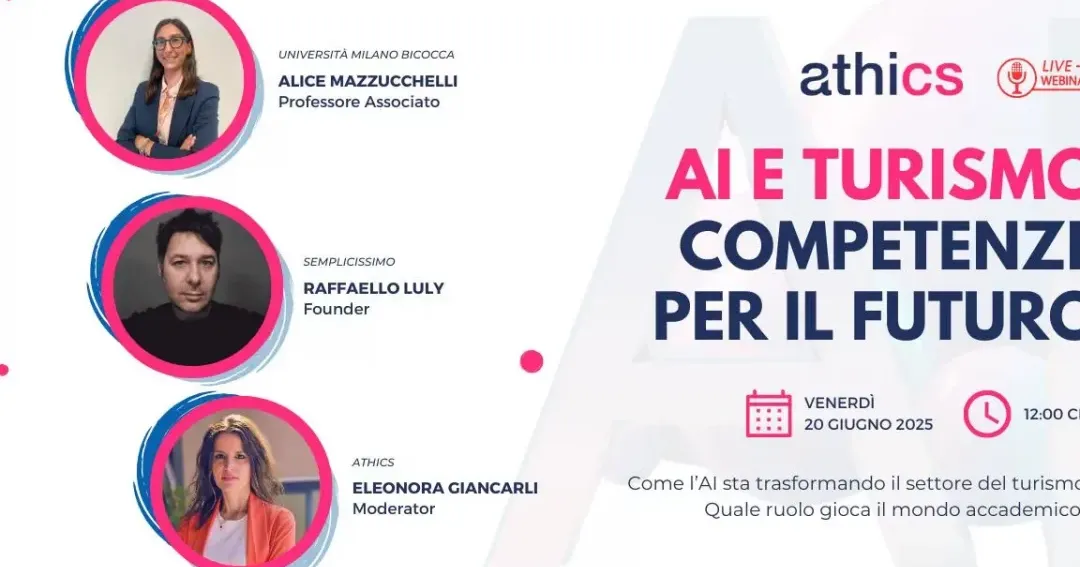
During the recent Athics webinar "AI and Tourism: Skills for the Future between Innovation and Training", we explored this revolution from the perspective of new technologies to adopt and new skills to acquire, together with Alice Mazzucchelli, Associate Professor at the University of Milan Bicocca and Senior Research Consultant at CRIET, and Raffaello Luly, Founder of Semplicissimo and travel tech expert.
Table of Contents
- AI in Tourism Scenario
- What are the most popular AI tools?
- From knowing how to do to knowing how to think: skills and roles
- How can AI enhance human skills?
- What are the emerging professional profiles?
- The most important human skill to cultivate
- How to implement AI in tourism
- FAQs about AI in Tourism
AI in Tourism Scenario {#ai-in-tourism-scenario}
The adoption of generative and conversational AI solutions is already a reality in the travel sector. According to the Amadeus report, 46% of tourism technology leaders consider AI in tourism a top priority, while the main barriers include a lack of skills. For this very reason, academic work to train new professional figures and acquire soft skills is essential.
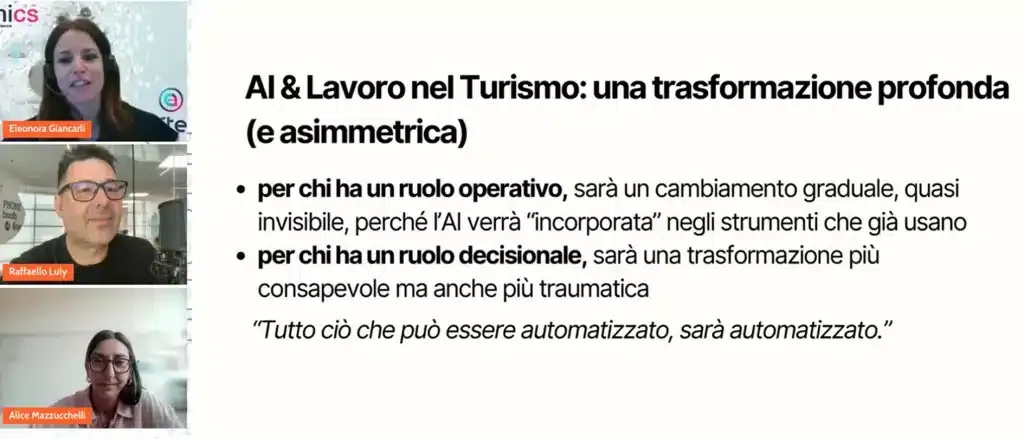
Tourism is one of the most dynamic economic sectors and, at the same time, one of the most exposed to digital disruption. The arrival of AI is not just a technological opportunity: it is a cultural and organizational challenge that requires a change in the way we think, train, and manage human resources. Companies that know how to integrate artificial intelligence and human intelligence synergistically will be the ones that lead innovation in the coming years.
What are the most popular AI tools? {#most-popular-ai-tools}
While there are still those who limit themselves to using generative AI to ask "Google-style" questions, companies are starting to use it as a true business assistant, tailored to their own data and processes. The growing trend is to integrate AI as a personalized business assistant that works on internal data and processes, rather than generic information.
This evolution translates into increasingly contextualized and vertical tools, including:
Intelligent chatbots trained on company data: virtual assistants capable of responding in natural language to complex questions about catalogs, travel packages, travel conditions, regulations, or specific promotions. These tools can handle hundreds of simultaneous requests 24/7, maintaining a consistent brand tone.
Automatic quote and itinerary generation systems: powered by generative AI, these tools help agencies create customized proposals in a few seconds, improving operational efficiency and the ability to respond quickly to customer requests.
Personalized recommendation engines: suggest destinations, experiences, or upgrades based on user behavior and preferences, increasing conversion rates and customer satisfaction.
Predictive demand analysis: using machine learning, it is possible to predict booking peaks, tourist flows, and traveller behavior to optimize supply and resource management. This type of analysis is particularly valuable for seasonal planning and dynamic pricing management.
AI for omnichannel customer service: integrated tools that automatically respond to emails, WhatsApp messages, reviews, or social comments, with a consistent language in line with the company's tone of voice.
These tools, if well implemented, do not replace human value but amplify it, allowing tourism operators to focus on more strategic and relational activities. AI in tourism, in this sense, is not just a tool, but a true digital colleague.
From knowing how to do to knowing how to think: skills and roles {#skills-and-roles}
The introduction of AI in tourism does not simply imply the adoption of new technological tools, but requires a deeper change: an evolution of skills and a redefinition of professional roles.
In the words of Raffaello Luly:
"The risk is to confuse the instrument with the musician. Owning a guitar does not mean having the skills of Jimi Hendrix. Similarly, accessing ChatGPT is not enough to create a valuable offer. You need to have knowledge and skills to ask the right questions to generative AI."
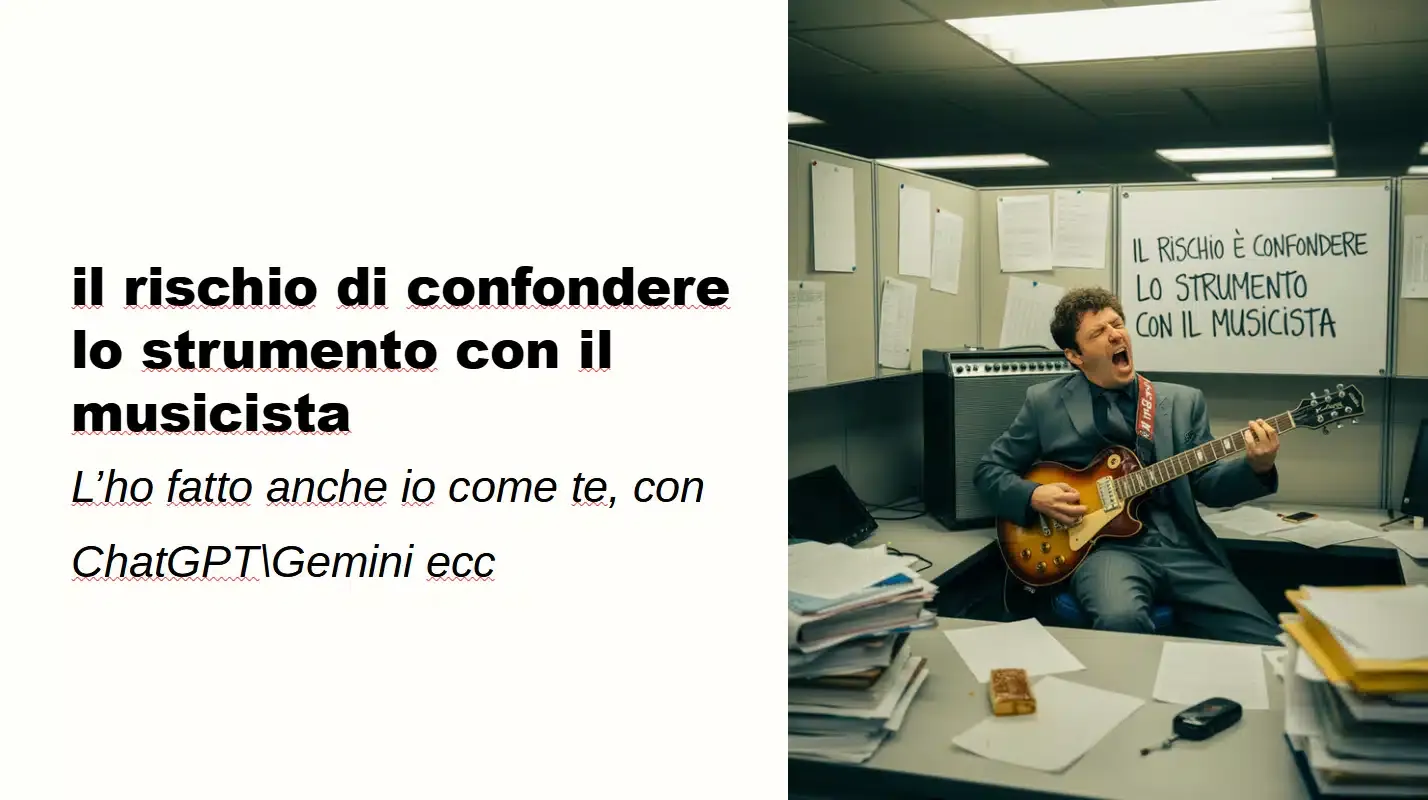
This reflection highlights a crucial aspect: AI in tourism is only powerful if guided by critical thinking, knowledge of the context, and the ability to interpret. It is not enough to "know how to do" in a technical sense — it is necessary to "know how to think" in a strategic, creative, and multidisciplinary way.
In concrete terms, this means that tourism professionals must acquire new digital skills, but also develop transversal skills such as formulating effective and relevant prompts, critically evaluating the content generated by AI, integrating AI responses into business processes in a coherent and distinctive way, and maintaining human control over the tone, the message, and the overall experience offered to the customer.
It is therefore not just a matter of learning to use a platform, but of rethinking one's role within the organization: from executive operator to curator of the experience, from information manager to orchestrator of intelligent processes.
According to Alice Mazzucchelli:
"The response of the academic field is precisely to adapt degree courses to intercept the real needs of companies, developing digital skills, but above all transversal soft skills, which are essential today to enter the world of work. In universities, the curricula of degree courses are being updated by inserting modules in machine learning, prompt engineering, design thinking, creative thinking, and business data science with the aim of combining managerial skills with business analytical skills. This is to be able to interpret artificial intelligence and not just use it."
How can AI enhance human skills? {#ai-and-human-skills}
In the words of Alice Mazzucchelli:
"Technology must not be opposed to human skills, but must be a complementary tool. We must enhance what AI cannot replicate, such as empathy, critical thinking, the ability to interpret, intercultural communication. All elements that bring value not only to the world of tourism, but in all sectors."
In short, it is not enough to use the tools to do the homework: we need to understand the logic and the impact that these technologies can have from a social and economic point of view. AI amplifies human capabilities, but requires that those who use it know how to guide it with awareness, strategic vision, and critical thinking.
What are the emerging professional profiles? {#emerging-profiles}
According to research by Dell Technology, 85% of the jobs that will exist in 2030 do not yet exist today. This data should make us reflect on the importance of developing transversal and adaptable skills, rather than specific skills tied to individual tools.
The most sought-after profiles that integrate digital and humanistic skills are data scientists, sustainability experts, digital marketing experts with a focus on AI and personalization, and user experience specialists.
In tourism specifically, profiles of experiential tourism experts, destination managers who know how to analyze data, and experts in sustainable and regenerative tourism are emerging. A transversal role of "AI Manager" could join these specialized profiles, capable of bringing AI innovation into all business processes, acting as a bridge between technical and strategic competencies.
The most important human skill to cultivate {#most-important-skill}
In the age of AI in tourism, the most important human skill is not knowing how to program or use a technological platform, but knowing how to interpret. As clearly emerged in the webinar, the key skills to develop are critical thinking, the ability to read the context, empathy, and relational skills.
Artificial intelligence is able to generate answers, but it does not know the "why" and the "for whom". It is human intelligence that gives meaning, places each content in the right scenario, and understands whether an answer is suitable for a given customer, tone, situation, or corporate value.
This implies that, even in the most automated processes, a figure is needed that is capable of asking the right questions, evaluating the relevance of the answers, and understanding the impact of technological choices on people. Without this conscious supervision, the risk is that of blindly relying on a powerful but impersonal tool.
The real skill of the future is not technical, but human: giving meaning to artificial intelligence through our emotional, social, and critical intelligence.
How to implement AI in tourism {#how-to-implement}
For companies in the tourism sector, the implementation of AI-based automation must start from a clear analysis of the company objectives. Here is a five-step pathway:
1. Define the goal: Speed up customer responses? Improve data analysis? Optimize quote management? Clarity on objectives is the prerequisite for any successful implementation.
2. Map existing processes: Understanding where there are inefficiencies, bottlenecks, or repetitive tasks is essential to identify the processes where AI can bring maximum value in the shortest time.
3. Explore available technologies: Many solutions are already "no-code," don't require internal developers, and can be quickly integrated into existing processes. This significantly lowers the barrier to adoption.
4. Evaluate initial support: A discussion with an expert can help you understand what the market offers today and how to adapt it to your specific reality. Not all solutions are equal and the wrong choice can cost time and money.
5. Choose secure and scalable tools: Prefer platforms that guarantee data security, privacy compliance (GDPR), and the possibility of growth over time, as AI use expands within the organization.
Want to discover how to integrate AI into your tourism business processes? Contact us for a free consultation.
FAQs about AI in Tourism {#faqs}
Where does a tourism SME start to adopt AI?
From clarifying your goals (e.g., improving customer response), exploring the available tools, and evaluating with an expert what can bring concrete value to your reality. The most effective starting point is usually a process with a high volume of repetitive requests.
Which AI tools are most used in tourism today?
ChatGPT and similar tools are the most popular, but dynamic pricing tools, predictive demand analytics, and personalized virtual assistants trained on sector-specific business data are also gaining popularity.
What skills are needed to use AI in tourism effectively?
In addition to basic digital skills, analytical skills, data interpretation, and soft skills such as empathy, critical thinking, and intercultural communication are needed. The ability to formulate effective prompts has become a key competency for getting the most out of generative AI.
Will AI replace tourism professionals?
No: AI amplifies human skills but cannot replace empathy, creative thinking, the ability to handle complex situations, and interpersonal relationships. Professionals who know how to work with AI will have a significant competitive advantage.
What are the risks of AI in tourism?
The main risks include over-dependence on technological tools, loss of the human touch in customer service, and data privacy risks. It is essential to maintain active human control over automated processes and choose GDPR-certified platforms.